

- This event has passed.
Understanding Cognitive Apprenticeship: Making Thinking Visible
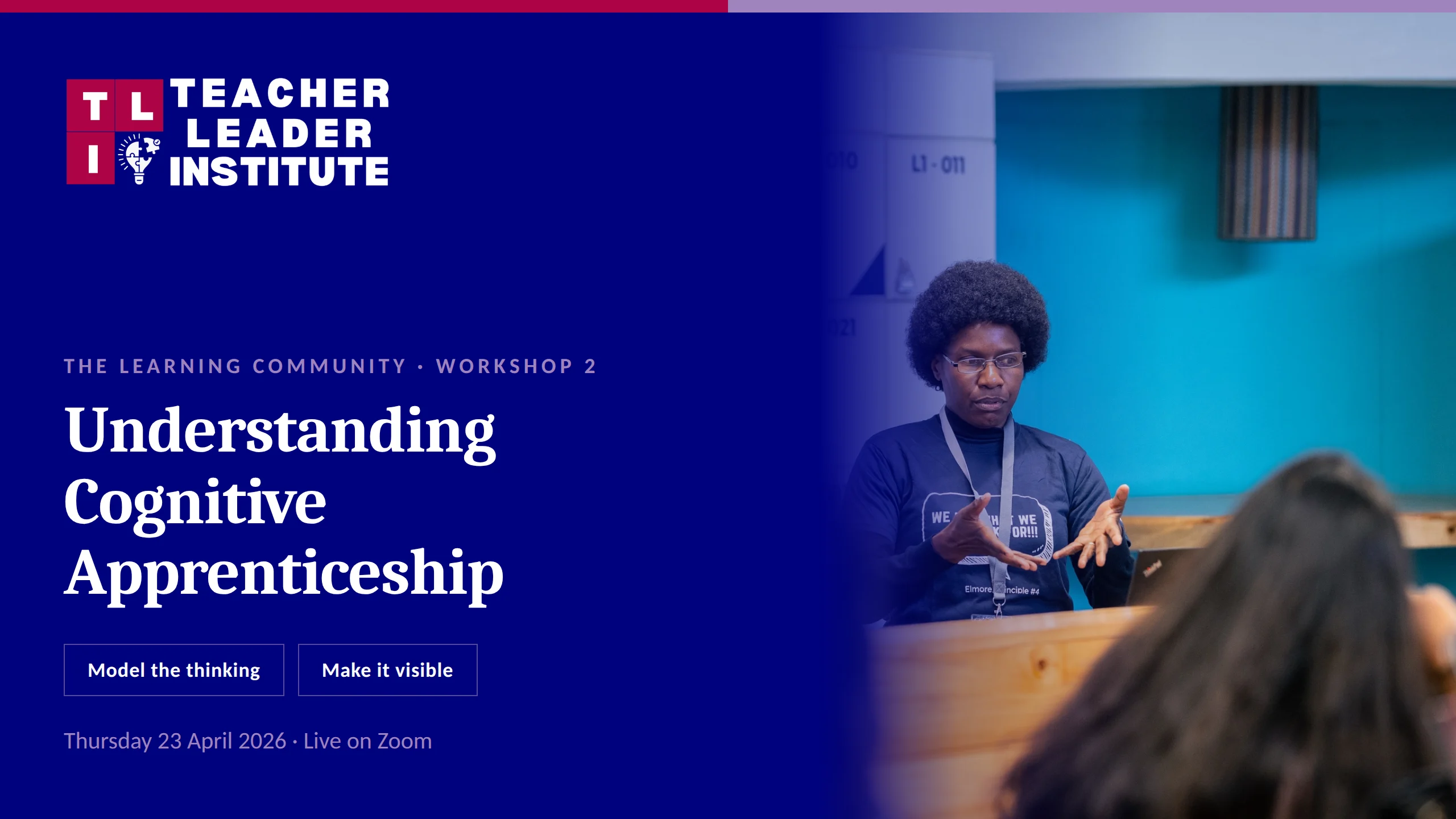
On 23 April 2026, the Learning Community met for its second workshop on cognitive apprenticeship. Ric Campbell opened it with a confession most teachers will recognise: after forty years of teaching, he has sat through a great deal of professional development that did him very little good. Quick, prescriptive, and hard to apply once the classroom door closed. This session set out to do the opposite, to work through an idea together rather than hand over a technique.
What we explored
The idea starts with a problem every teacher knows. You explain a mathematics problem clearly. The students nod. Then you set a similar problem, and they cannot do it. The same happens with a story discussed as a class, or a piece of historical reasoning. Researchers call this the problem of transfer, and transfer is the truest sign that something has actually been learned.
Ric traced it to a single cause: we cannot do what we cannot see. A football coach can show a move. A tailor can show an apprentice how cloth is cut. But no one can watch a mathematician think, or see a historian weigh a source. The thinking that does the real work in school subjects stays invisible, so students are left to guess at it.
Cognitive apprenticeship, developed from the work of Jean Lave and Etienne Wenger, treats the teacher as the master and the student as an apprentice in thinking. The teacher’s job is to make the invisible visible: to think aloud, to model the struggle rather than only the polished answer, to show the false starts and the strategy. As Ric put it in the second workshop, our task is to be the historian or the scientist we want our students to become, and to let them watch how we work.
Watch the full session
The complete workshop, including the discussion with teachers from across the community, is on our YouTube channel.
What we read
- Collins, A., Brown, J. S., & Holum, A. (1991). Cognitive Apprenticeship: Making Thinking Visible. American Educator, 15(3), 6–11.
- Lave, J., & Wenger, E. (1991). Situated Learning: Legitimate Peripheral Participation. Cambridge University Press.
Next in the series
Learning from Our Community: Stories and Strategies from the Classroom
Thursday 2 July 2026
The third workshop changed shape. Instead of a facilitator at the front, teachers from across the community shared what they had actually tried in their own classrooms, and what happened.